Veterans Health Administration (VHA), Health Information Technology (HIT) Modernization
eHMP | Journey Mapping to Understand the Veteran Patient Experience
2017-18, VHA, Human Factors Engineering Office (HFE)


Project Context
The U.S. Department of Veterans Affairs is undertaking a large-scale modernization to transform how health services are delivered nationwide. Health Information Technology is a central component of this effort, with direct implications for clinical decision-making, care coordination, and patient outcomes.
Within this context, Human Factors Engineering (HFE) supported modernization by translating research evidence into structured representations of real clinical work—making decision paths, breakdowns, and opportunities visible across roles and systems.
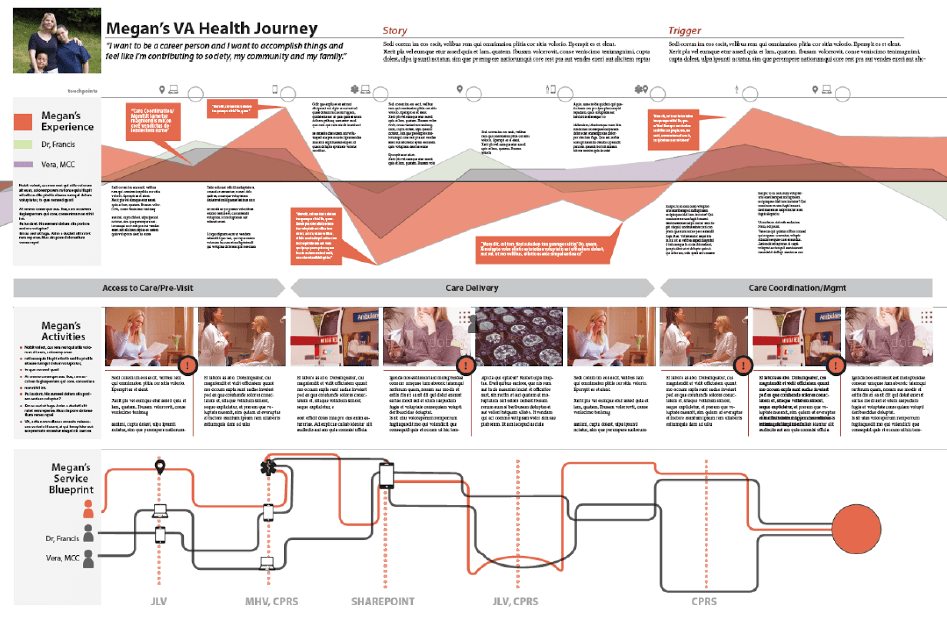
I supported the development of Meghan’s Journey, a six-part, multi-perspective analysis of maternity care workflows across VA systems.
This work captured three viewpoints—the Primary Care Physician, the Veteran, and the Maternity Care Coordinator—modeled in both current-state (“As Is”) and future-state (“To Be”) scenarios to surface gaps, decision points, and coordination failures.
My contributions included:
- Synthesizing qualitative and quantitative research data into narrative scenarios that reflected real clinical decision contexts
- Identifying pain points, handoffs, and information gaps that affected care coordination and judgment
- Conducting literature reviews and comparing industry best practices to identify design opportunities
- Mining HFE datasets and prior studies to document recurring clinical scenarios and unmet business needs
- Supporting the development of a knowledge management system to capture, organize, and relate scenarios, journey maps, personas, and supporting evidence
Decision-Support Highlights
To support analysis and reuse at scale, I designed a custom data model and database to manage and visualize journey map content.
This system allowed teams to:
- View all information related to a clinical event in one place
- Trace relationships between roles, touchpoints, and evidence
- Brainstorm improvements grounded in research and prior findings
- Maintain citations to clinical research and industry best practices
By structuring journey data in this way, the work moved beyond static artifacts and became a decision-support resource—supporting sensemaking, design exploration, and future-state planning across teams.

