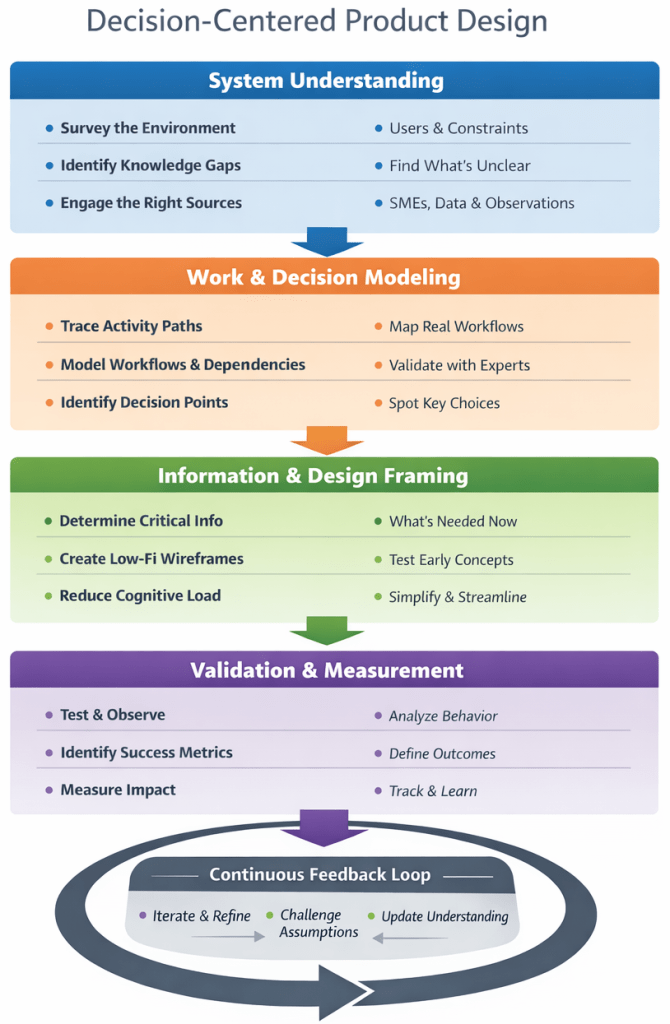
I approach design as a process of reducing uncertainty in complex systems. In short, I follow these steps:
- Survey the system — understand context, constraints, and unknowns
- Close knowledge gaps — engage people, data, and artifacts
- Trace real work — model workflows and validate them with experts
- Design for decisions — identify critical information at key moments
- Test structure early — low-fidelity designs to validate direction
- Measure what matters — define signals that confirm or challenge success
The approach described here shows up across my project work, research, and writing. In the Portfolio, you’ll find examples of how these principles are applied in practice—across healthcare, government, cybersecurity, enterprise platforms, and AI-enabled systems. Projects range from early-stage research and system modeling to usability engineering, accessibility, and design strategy.