
Book 2 expands the lens of the first volume from individual tools and workplace systems to the broader conditions that sustain human cognition over time.
While Book 1 examines how AI design choices shape judgment, learning, and expertise within specific systems, Book 2 explores how those same forces interact with the social, cultural, and institutional structures that anchor identity, responsibility, and meaning. These structures—what this book refers to as identity stabilizers—play a critical role in how people develop judgment, regulate attention, and think critically across contexts and across generations.
As AI becomes a pervasive cognitive intermediary, its influence no longer stops at the interface or the workflow. It alters how information is encountered, how norms are reinforced, and how authority and trust are established. Book 2 examines these effects at scale.
Identity Stabilizers and Cognitive Resilience
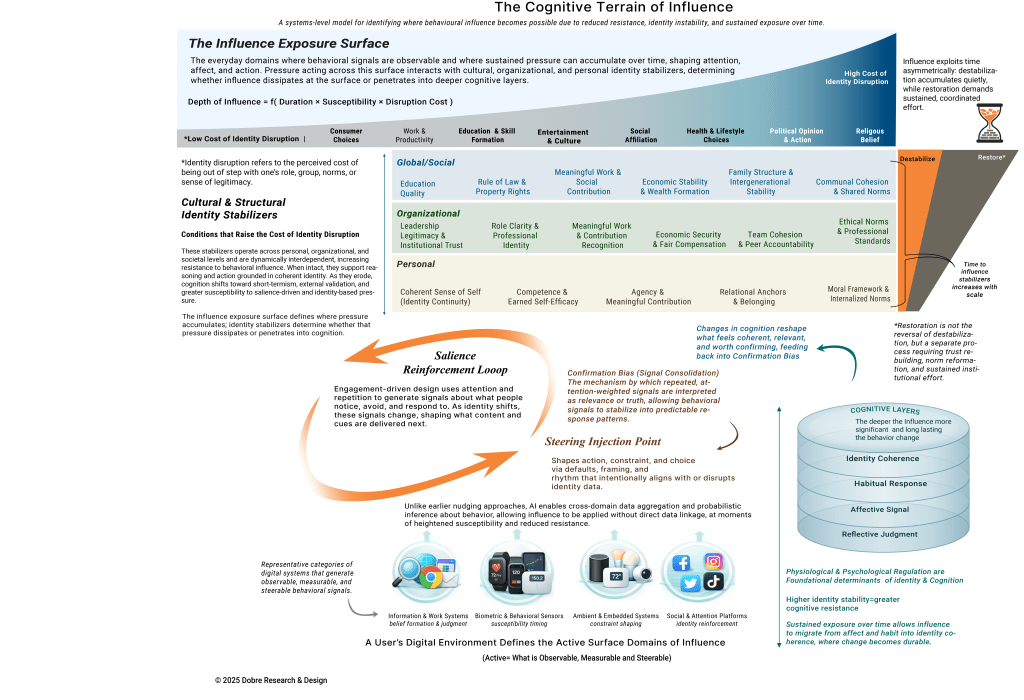
A central focus of Book 2 is the role of identity stabilizers: enduring structures that help individuals and communities maintain continuity, orientation, and accountability over time.
These include elements such as family structures, education systems, meaningful work, religious and civic institutions, shared norms, economic participation, and local communities. Historically, these stabilizers have provided the scaffolding through which judgment is formed, responsibility is learned, and critical thinking is exercised within real social constraints.
Book 2 examines how AI-mediated systems interact with these stabilizers—sometimes reinforcing them, sometimes bypassing them, and sometimes quietly weakening them by substituting algorithmic signals for human judgment, tradition, or shared accountability. Rather than treating cultural change as abstract or inevitable, the book traces how specific design choices, incentive structures, and information flows affect identity formation and cognitive resilience over time.
The question is not whether these stabilizers change, but whether systems are designed with an understanding of what they replace, distort, or displace.
From Tools to Environments
Where Book 1 focuses on decision-support systems, automation, and AI-enabled workflows, Book 2 shifts attention to the environmental layer in which those systems operate.
This includes:
- how attention is shaped and fragmented
- how norms are reinforced or eroded
- how shared understanding forms—or fails to form
- how institutions maintain memory and continuity
- how individuals retain the ability to reason independently
Book 2 argues that critical thinking is not sustained by information alone, but by structures that support reflection, responsibility, and consequence. When those structures weaken, even well-designed tools can accelerate cognitive erosion rather than prevent it.
The Influence Surface
To make these interactions visible, Book 2 introduces and develops visual frameworks—most notably the Influence Surface—to model how technological systems intersect with social, economic, and cultural stabilizers.
The Influence Surface is not a predictive model or a moral framework. It is a way of mapping pressure: showing where AI systems amplify, distort, or displace stabilizing forces that support judgment and identity over time. This framework is used to examine patterns rather than prescribe outcomes, allowing design decisions to be evaluated based on their observable effects rather than their stated intentions.
Related Essays
Several themes in this book are explored in greater depth through related public essays. These pieces examine specific ideas and frameworks as they are developed and refined, and are linked below where they align most directly with this volume.
- We’ll Have More Shelf Space
- Why Australia’s Social-Media Ban for Kids Makes Sense — and Why Other Nations Should Pay Attention
- The Salience Reinforcement Loop
- Why It’s Getting Harder to Hold Nuanced Positions
- Why Every Nation Needs Its Own AI System
Relationship to Book 1
The two books are designed to be read together.
- Book 1 addresses how AI reshapes judgment and expertise within specific tools, workflows, and decision contexts.
- Book 2 examines how those same forces scale outward, shaping identity, cognition, and resilience across institutions and culture.
Together, they form a layered examination of human intelligence under automation—from individual judgment to collective capacity.

