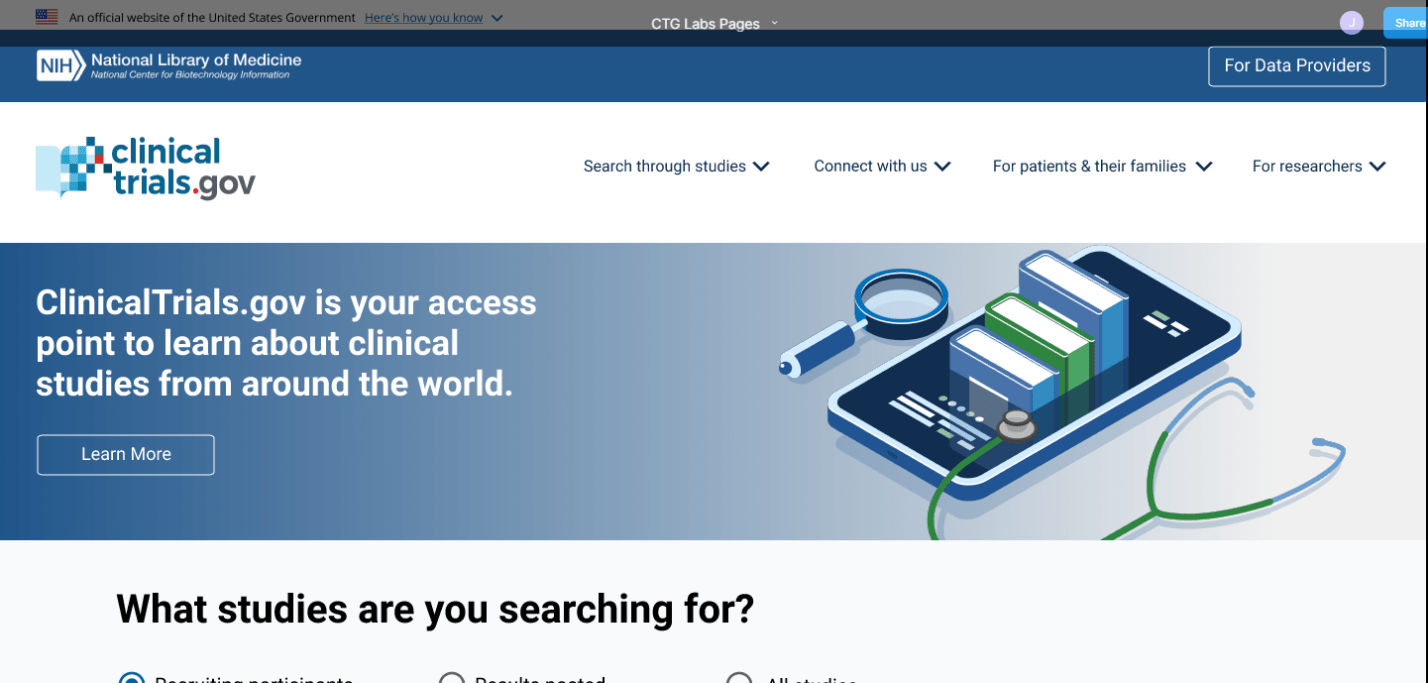
National Library of Medicine (NIH) ClinicalTrials.gov (CTG) and the Protocol Registration and Results System (PRS) legacy systems for trial discovery and protocol regulation
2019-2021, ICF/ICF NEXT supporting NIH NLM ClinicalTrials.gov (In development)
Project Context | My Role | Highlights


Project Context
ClinicalTrials.gov is the world’s largest public database of privately and publicly funded clinical trials, serving millions of users each month—including patients, advocates, researchers, trial sponsors, and regulatory reviewers.
The platform includes:
- the access-controlled PRS system for regulatory review and evaluation
- the public-facing ClinicalTrials.gov site for search and discovery
- the access-controlled CTG system for trial submission and maintenance
Prior to modernization, both public and internal systems suffered from significant usability and accessibility challenges, inefficient and error-prone workflows, fragmented navigation, and an aging technology stack. These issues directly affected data quality, regulatory review, and public access to critical research information.
My Role
In July of 2019 NLM approached ICF to perform a stakeholder analysis to set the groundwork for stakeholder engagement for the multi-year modernization effort. I performed the analysis and evangelized the benefits of a user-centered design approach. My work led to ICF’s selection as the design team for the larger modernization effort.
- Project Lead, managed a team of 7+ designers, researchers, and content writers
- Discovered, captured, and aggregated stakeholder information
- Developed an interactive Kumu data model of stakeholders, their needs, behaviors and interactions
- Oversaw stakeholder engagement activities such as workshops, board of regent presentations, and socializing conceptual designs and engagement strategies
- Conducted User Research
- Oversaw and conducted user interviews
- Performed cognitive task analysis of NLM PRS study reviewers as they reviewed trials, and external
- Documented workflows, information needs, information flows
- Coded user data from stakeholder engagement activities, interviews, observations and CTG users as they attempted to input and maintain trial data
- Observed interactions between reviewers and clinical trial submitters
- Presented findings
- Created wireframes, conducted User Testing
Accessibility and Usability Engineering Highlights
This work treated accessibility and usability as system-level requirements, not compliance afterthoughts.
Key outcomes included:
- Making complex regulatory workflows visible and analyzable across roles
- Identifying structural barriers that affected efficiency, accuracy, and accessibility for diverse user groups
- Providing evidence-based input that shaped modernization scope and priorities
- Establishing a shared understanding of user needs that could be carried forward into design, development, and procurement
As a result of this foundational work, NLM issued a modernization RFP that explicitly reflected user-centered design and human factors methods aligned with ICF’s approach.
Program Outcome
Update: In June of 2023 CTG reached an important milestone: replacing the current website with the modernized ClinicalTrials.gov website. The new platform reflects years of iterative design, research, and engineering aimed at improving accessibility, usability, and trust in a critical national information resource. You can read about the modernization effort and experiment with the beta site.

